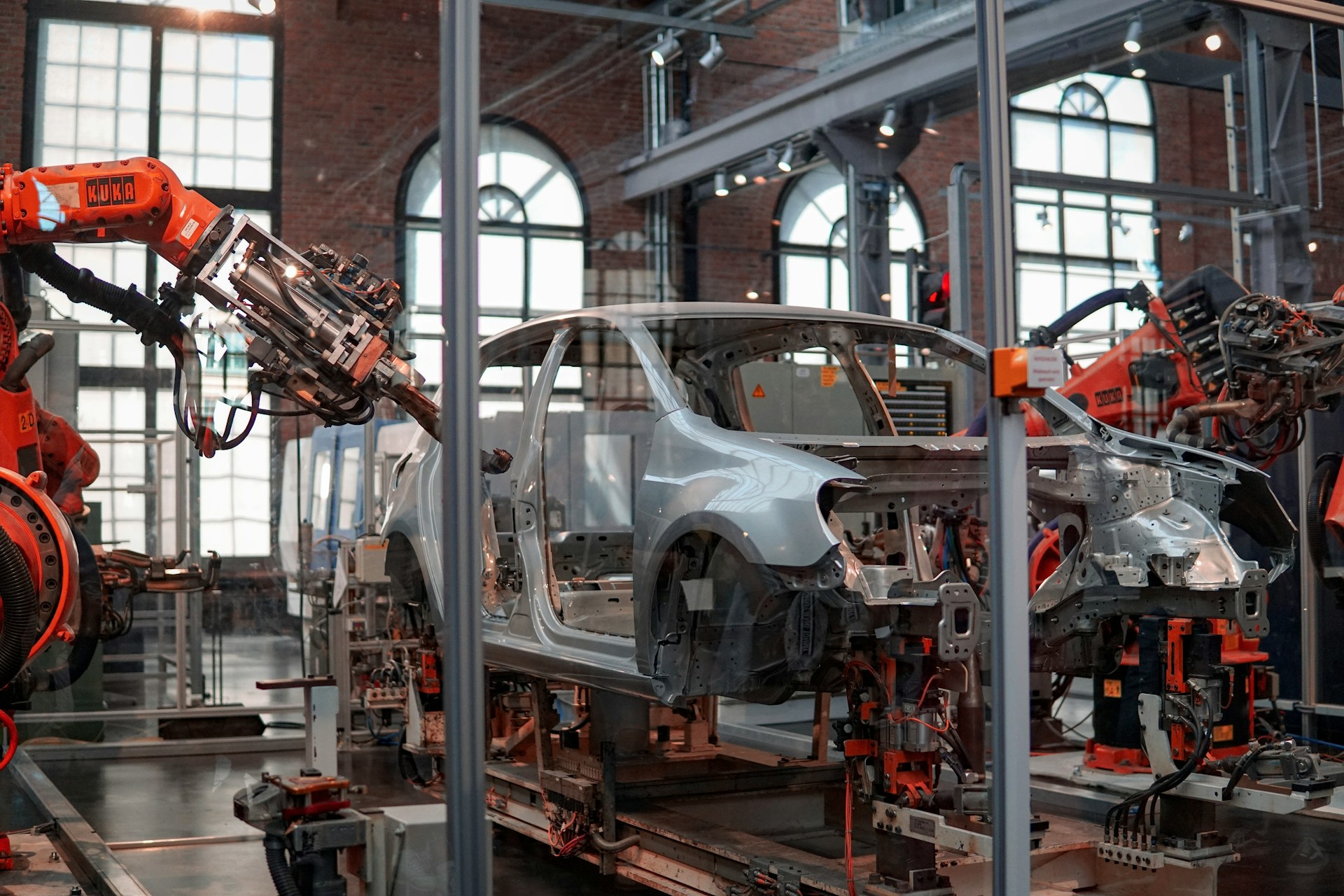

US motor vehicles and parts employment was 962,800 in August 2026, down 4,500 on the month and flat over the year. Production workers averaged 45.6 hours a week, up from 42.6, and overtime reached 6.5 hours in July. Plants are running existing crews harder rather than adding heads, even with sales at a 16.8 million annual pace.
Sources: BLS Current Employment Statistics, series CES3133600101, CES3133600107 and CES3133600109, seasonally adjusted, August 2026 preliminary; Cox Automotive, September 2, 2026.What do the numbers say?
Motor vehicles and parts was the only major durable goods category in the August Employment Situation to lose jobs. Manufacturing as a whole added 16,000 and durable goods 15,000; autos gave back 4,500. Over 12 months the industry is down 400 jobs, a rounding error on a base of 963,000. The hours data tell the real story. The production workweek is three hours longer than a year ago, overtime is up more than half an hour, and hourly earnings for production workers rose 5.0 percent, faster than the 4.4 percent for all manufacturing and well ahead of 3.4 percent inflation.
| Measure, motor vehicles and parts | A year earlier | Latest | Change |
|---|---|---|---|
| All employees | 963,200 (Aug 2025) | 962,800 (Aug 2026, preliminary) | down 400; down 4,500 on the month |
| Average weekly hours, production workers | 42.6 (Aug 2025) | 45.6 (Aug 2026) | +3.0 hours |
| Average weekly overtime, production workers | 5.9 (Jul 2025) | 6.5 (Jul 2026, preliminary) | +0.6 hours |
| Average hourly earnings, production workers | $32.64 (Aug 2025) | $34.27 (Aug 2026) | +5.0 percent |
| Manufacturing, all industries: weekly hours and overtime | 40.5 hours; 3.1 overtime (Aug 2026) | Autos run 5 hours longer with double the overtime |
Why are plants stretching instead of hiring?
Because demand is good and the cost picture is not. New vehicle sales ran at a seasonally adjusted annual rate of 16.8 million in August, the strongest month of 2026 and the sixth straight month above 16 million, the longest such streak since March 2020 (Cox Automotive). The year to date pace of 16.1 million sits above Cox's full year forecast of 15.9 million. Inventory at the start of September was 2.68 million units, 73 days of supply, the lowest since April 2025, with Toyota at 33 days and Honda at 41 (Cox Automotive vAuto). Lean lots and steady sales are exactly the conditions that normally trigger a second shift or a new hiring wave.
Three things are holding it back. First, tariff cost. Imported vehicles and many parts carry a 25 percent Section 232 tariff, and the offset US assemblers receive on parts fell from 3.75 percent of vehicle value to 2.5 percent on May 1, 2026, expiring April 30, 2027 (US Department of Commerce). On August 22, 2026 the United States imposed 50 percent tariffs on Canadian goods after trade talks failed, which the Detroit Regional Chamber warned would bring "economic pain on both sides of the border." Second, the EV reset. Electric vehicles were 5.8 percent of second quarter sales, down 20.5 percent from a year earlier and far below the 10.6 percent record of the third quarter of 2025, while hybrids reached 15.7 percent of August sales (Cox Automotive; NADA). Plants built for EV volume are on one shift; plants building trucks and hybrids are on overtime. Third, uncertainty itself. When the mix and the tariff schedule can both change within a quarter, a manager buys hours from the crew already on the floor before adding a person with a 90 day evaluation clock.
Sources: Cox Automotive, August 2026 sales forecast, September 2, 2026, and new vehicle inventory report, September 10, 2026; US Department of Commerce, auto tariff offset process, June 12, 2025; Detroit Regional Chamber statement, August 22, 2026; Cox Automotive Q2 2026 EV sales report, July 10, 2026; NADA Market Beat, September 9, 2026.Where are shifts being cut and where is hiring planned?
| Site | Action | People | Source |
|---|---|---|---|
| GM Factory Zero, Detroit and Hamtramck | Cut to one shift, January 5, 2026, citing slower EV adoption | About 1,200 layoffs across Factory Zero and battery plants | Fox 2 Detroit, October 29, 2025 |
| GM Fairfax, Kansas | Second shift idled September 2025; return expected mid 2027 after Equinox retool | About 870 working, about 750 on layoff | KSHB, 2026 |
| Ford Louisville Assembly, Kentucky | Retooling for a midsize electric pickup; production 2027 | About 2,000 temporarily laid off for roughly 10 months | NBC News, August 11, 2025; Ford |
| Toyota San Antonio, Texas | $3.6 billion second Tacoma line | 2,000 new jobs by 2030 | Toyota, July 6, 2026 |
| Stellantis, four state program | $13 billion over four years | More than 5,000 jobs | Stellantis, October 14, 2025 |
| Hyundai Motor Group, US | $21 billion commitment, 2025 to 2028 | About 14,000 direct jobs | Hyundai, March 26, 2025 |
| Scout Motors, Blythewood, South Carolina | $2 billion plant plus $300 million supplier park; vehicles 2028 | More than 4,000 permanent jobs; 200 to 300 hires in 2026 | Scout Motors, August 6, 2026; Post and Courier, April 20, 2026 |
| BMW Plant Woodruff, South Carolina | Battery assembly series production, December 2026 | More than 300 employees | BMW, July 27, 2026 |
The pattern is national: EV dedicated capacity is on reduced shifts while truck, SUV and hybrid capacity runs long. Supplier headcount is where the strain shows first. One state example, clearly labeled: Michigan motor vehicle parts manufacturing employed 109,500 in June 2026 against 113,600 in June 2025, down 4,100, while Michigan vehicle assembly employment rose to 46,500 from 46,000 over the same months (BLS state series SMU26000003133630001 and SMU26000003133610001, not seasonally adjusted). Assembly plants held their people. Their suppliers did not.
Which roles are hardest to fill when hiring does resume?
Not the assembly line. Deloitte's 2026 manufacturing outlook found more than a third of 600 executives citing worker skills as the top concern for smart manufacturing, and reported that immigrant workers filled nearly one in four US manufacturing production jobs in 2024. The roles growing around robots, vision systems and battery lines are the ones plants struggle to staff.
| Occupation (national, all industries) | Median pay, May 2025 | Projected growth, 2025 to 2035 | Annual openings |
|---|---|---|---|
| Industrial machinery mechanics | $64,520 | +18 percent | 51,900 (with maintenance workers and millwrights) |
| Industrial engineers | $102,440 | +12 percent | 23,100 |
| Electricians | $63,190 | +9 percent | 72,700 |
| Electrical engineers | $120,630 | +10 percent | 16,300 (with electronics engineers) |
| Machinists | $58,750 | +1 percent | 30,400 (with tool and die makers) |
| Tool and die makers | $64,050 | down 9 percent | Included above |
| Quality control inspectors | $48,570 | +3 percent | 66,700 |
| Assemblers and fabricators | $45,450 | +1 percent | 177,500 |
What happens when overtime runs this long?
Historically, sustained overtime in autos resolves one of two ways: the plant hires if demand holds, or it adds temporary and contract labor to relieve the crew while it waits to find out. With the UAW's Detroit Three contracts running to April 30, 2028, and the union's officer election ballots due October 5, 2026, the large assembly plants have little room to change staffing models this year. Their suppliers do. Forecasters cluster around 16.0 to 16.1 million sales for 2027 (NADA; Deutsche Bank via AutoGuide), and S&P Global Mobility revised its 2027 North American production forecast up 224,000 units in August. Flat to slightly higher volume with a reduced parts offset means suppliers will keep covering demand with hours until margin allows heads.
Sources: Labor Notes, August 25, 2026; NADA Market Beat, September 9, 2026; S&P Global Mobility, August 2026 production forecast.What this means if you hire
Six and a half hours of weekly overtime is a cost line and a retention risk at the same time. Production pay in autos is up 5.0 percent in a year because plants are paying people to stay.
- Temp to hire relieves the crew now and converts when the tariff and mix picture clears. The 90 day evaluation runs on your floor, not on a resume.
- Maintenance technicians, controls and automation technicians and quality engineers are the seats that stay open. Start those searches before the overtime does the retaining for you.
- If you supply a plant on one shift and a plant on overtime, staff to the second and flex the first. That is what contract labor is for.
What this means if you work
Auto plants are not laying off in large numbers outside EV and battery sites. They are asking the people they have to work longer, and paying more for it.
- Truck, SUV and hybrid plants and their suppliers are the ones running long weeks. Ask about overtime availability and the shift schedule before you accept.
- Skills that service robots, vision systems and PLCs are the fastest route from the line to a technician role that plants cannot fill.
- Hiring announcements with dates: Toyota San Antonio through 2030, BMW Woodruff this December, Scout Motors through 2028, Ford Louisville in 2027, GM Fairfax second shift in mid 2027.
Assembly, press operators, quality inspectors, tool and die, maintenance and controls engineers for Tier 1 and Tier 2 suppliers, stamping and battery plants.
Book a meeting Call (734) 552-5731Sources
- BLS, Current Employment Statistics, motor vehicles and parts: employment CES3133600101 data.bls.gov; weekly hours CES3133600107 data.bls.gov; overtime CES3133600109 data.bls.gov; hourly earnings CES3133600108 data.bls.gov
- BLS, The Employment Situation, August 2026, Tables B1 and B2, released September 4, 2026. bls.gov/news.release/empsit.t17.htm
- BLS, state CES series: Michigan motor vehicle parts manufacturing data.bls.gov; Michigan motor vehicle manufacturing data.bls.gov
- Cox Automotive, August 2026 US auto sales forecast, September 2, 2026. coxautoinc.com
- Cox Automotive, August 2026 new vehicle inventory, September 10, 2026. coxautoinc.com
- Cox Automotive, Q2 2026 EV sales report, July 10, 2026. coxautoinc.com
- NADA Market Beat, August 2026, via MOTOR, September 9, 2026. motor.com
- US Department of Commerce, auto tariff offset process, June 12, 2025. trade.gov
- Detroit Regional Chamber, statement on US and Canadian trade relations, August 22, 2026. michauto.org
- Fox 2 Detroit, GM Factory Zero shift reduction, October 29, 2025. fox2detroit.com; KSHB, GM Fairfax, 2026. kshb.com
- NBC News, Ford Louisville Assembly retooling, August 11, 2025. nbcnews.com; Ford, Universal EV production system progress, 2026. fromtheroad.ford.com
- Toyota, $3.6 billion San Antonio expansion, July 6, 2026. pressroom.toyota.com
- Stellantis, $13 billion US investment plan, October 14, 2025. media.stellantisnorthamerica.com
- Hyundai Motor Group, US investment commitment, March 26, 2025. hyundai.com
- Scout Motors, July 2026 production center update, August 6, 2026. blog.scoutmotors.com; Post and Courier, April 20, 2026. postandcourier.com
- BMW Group, Plant Woodruff first high voltage batteries, July 27, 2026. press.bmwgroup.com
- Deloitte, 2026 Manufacturing Industry Outlook, November 13, 2025. deloitte.com
- BLS Occupational Outlook Handbook: industrial machinery mechanics bls.gov/ooh; electricians bls.gov/ooh; industrial engineers bls.gov/ooh; electrical and electronics engineers bls.gov/ooh; machinists and tool and die makers bls.gov/ooh; quality control inspectors bls.gov/ooh; assemblers and fabricators bls.gov/ooh
- Labor Notes, UAW international officer election, August 25, 2026. labornotes.org
- S&P Global Mobility, 2026 light vehicle production forecast, August 2026 update. mobilityglobal.com
Production note: drafted from the primary sources listed above with AI assistance, then reviewed and edited by Kenneth Cuzelis before publication. Read how we source and grade every number. Corrections: info@c3workforce.com or (734) 552-5731.