
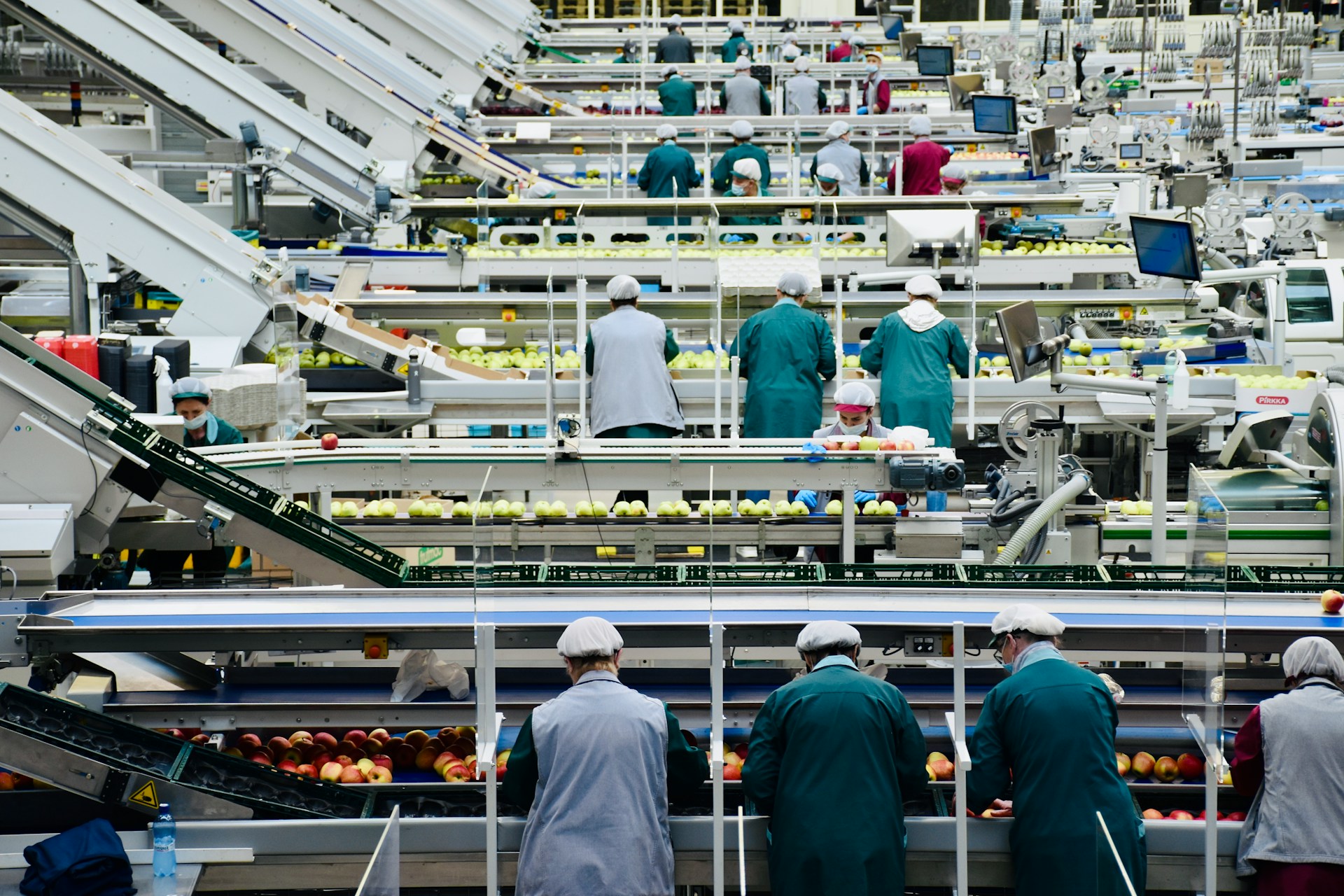
Food manufacturing employed 1,764,600 people in August 2026, down 20,400 or 1.1 percent in a year and the lowest since 2023, while production pay rose 3.25 percent to $24.78 an hour. Beef plant closures and snack consolidation are cutting heads; dairy, protein beverage and poultry plants are adding them. Maintenance technicians and sanitation are the hardest seats to fill.
Sources: BLS Current Employment Statistics, series CES3231100001 and CES3231100008, August 2026 preliminary, seasonally adjusted; company releases and state economic development announcements cited below.What happened to food manufacturing jobs?
After a decade of almost uninterrupted growth, food manufacturing payrolls peaked in mid 2025 and have fallen every month since April 2026. The August level is 1,764,600, against 1,785,000 a year earlier. Production and nonsupervisory employment fell 10,800 to 1,389,600. The industry's own unemployment rate was 5.7 percent in August, not seasonally adjusted, against 4.1 percent nationally. Output tells the same story: the Federal Reserve's industrial production index for food manufacturing was down 1.6 percent from a year earlier in July, and capacity utilization slipped to 77.3 percent from 79.4 percent. Dollar shipments were up 1.4 percent: revenue is holding on price, not volume.
| Measure | Latest | Period | Change |
|---|---|---|---|
| All employees, food manufacturing | 1,764,600 | August 2026 | down 20,400 (1.1 percent) from August 2025 |
| Production and nonsupervisory employees | 1,389,600 | August 2026 | down 10,800 |
| Unemployment rate, food manufacturing industry | 5.7 percent | August 2026 | National rate 4.1 percent |
| Industrial production index, food (2017 = 100) | 97.99 | July 2026 | down 1.6 percent from 99.57 |
| Capacity utilization, food manufacturing | 77.3 percent | July 2026 | 79.4 percent a year earlier |
| Value of shipments, food products | $90.9 billion | July 2026 | up 1.4 percent |
| Labor productivity, food manufacturing | down 2.1 percent | 2025 | Unit labor costs up 5.6 percent |
Why is pay rising while jobs fall?
Because the supply of authorized hourly workers is shrinking faster than demand. Food manufacturing production pay of $24.78 is up 3.25 percent over the year, ahead of the 3.1 percent gain for all private workers and the 2.2 percent rise in food at home prices. It is still $5.59 below the $30.37 average for all manufacturing production workers, and that gap is why food plants lose people to durable goods plants: nondurable goods openings fell to 151,000 in July 2026 from 172,000 a year earlier while durable goods openings jumped to a 5.2 percent rate. Overtime in food plants ran 4.2 hours a week in July, more than a full hour above the manufacturing average, which is what thin staffing on production and sanitation shifts looks like in the data.
Turnover has cooled. The monthly quits rate in nondurable goods manufacturing was 1.5 percent in July 2026, half the 2.9 percent average of 2022. But the workforce that fills these plants is disproportionately foreign born: Hispanic or Latino workers were 30.1 percent of food manufacturing employment in 2025 and 37.4 percent of animal slaughtering and processing, against 18.7 percent of all manufacturing (BLS Current Population Survey). Work authorization changes hit this workforce directly. The Supreme Court allowed the termination of Temporary Protected Status for Haiti in 2026, and USCIS announced on September 11 that it had already reached the H 2B cap for the first half of fiscal 2027. Plants that hired TPS holders in 2022 to 2024 must reverify on expiration and backfill.
Sources: BLS CES series CES3231100008 and CES3231100009; BLS Employment Situation Tables B2 and B8, August 2026; BLS CPI, August 2026; BLS JOLTS Tables 1 and 4, July 2026, and FRED series JTS3400QUR and JTS3400TSR; BLS CPS Table 18, 2025 annual averages; USCIS alert, September 11, 2026.Where are the closures and where are the openings?
The cuts are concentrated in beef, snacks and cereal. Tyson Foods, expecting beef segment losses of $500 million to $650 million in fiscal 2026, closed plants in Nebraska, Illinois and Utah this year. Campbell's is closing three plants and cutting 13 percent of its salaried workforce after snack sales fell 12 percent in its latest quarter. The Ferrero owned WK Kellogg Co closed its Omaha cereal plant (451 jobs) on August 17. The openings are in dairy, protein beverages, poultry and confectionery.
| Company and site | Action | Jobs | Investment and timing |
|---|---|---|---|
| Tyson Foods, Lexington NE; Joslin IL; Eagle Mountain UT; Rome GA | Beef and prepared foods closures | 3,212; more than 2,500; 723; 168 | January to August 2026 |
| Campbell's, Tualatin OR; Jeffersonville IN; Hyannis MA | Three plant closures, 13 percent salaried cut | 330; 111; 49 | Phased through 2026; $500 million savings target by fiscal 2030 |
| JBS USA, Souderton PA | Beef harvest ended; value added transition | About 1,700 ended, about 400 retained | June 2026; $30 million |
| Chobani, Allentown PA | New dairy and protein beverage campus | More than 900 over five years | $1.2 billion; five year buildout |
| Smithfield Foods, Sioux Falls SD | Replacement pork plant | Replaces a 117 year old plant | Up to $1.3 billion; production by end of 2028 |
| Ferrara Candy, Orangeburg County SC | New confectionery plant | 1,000 over 10 years | $675 million; first lines Q1 2029 |
| fairlife (Coca Cola), Coopersville MI | Dairy expansion | About 200 | $650 million; groundbreaking August 5, 2026 |
| Chobani (La Colombe), Norton Shores MI | Coffee and dairy expansion | 337 new, 312 retained | Up to $567 million; groundbreaking June 2, 2026 |
| Walmart, Robinson TX | Third owned milk plant | More than 400 | $350 million; opened April 29, 2026 |
| JBS USA, Perry IA | New sausage plant | 500 direct | $135 million; operations late 2026 |
| Pilgrim's Pride, Walker County GA | Prepared foods plant | Not restated | About $400 million; groundbreaking fall 2026 |
What do food plant jobs pay?
BLS Occupational Employment and Wage Statistics for May 2025 put the median hourly wage across all occupations in food manufacturing at $21.66. Sanitation, hand packing and meat cutting are the lowest paid and hardest to hold; maintenance mechanics sit at the top of the hourly ladder.
| Occupation | Median hourly, all industries | Median hourly within food manufacturing |
|---|---|---|
| First line supervisors of production workers | $35.79 | Not published |
| Industrial machinery mechanics | $31.02 | $30.72 |
| Maintenance and repair workers, general | $23.84 | Not published |
| Inspectors, testers, sorters, samplers and weighers | $23.35 | $22.17 |
| Industrial truck and tractor operators (forklift) | $22.32 | $21.85 |
| Packaging and filling machine operators | $20.78 | $21.32 |
| Food batchmakers | $20.33 | $21.07 |
| Slaughterers and meat packers | $19.29 | Not published |
| Meat, poultry and fish cutters and trimmers | $18.41 | Not published |
| Janitors and cleaners (sanitation proxy) | $17.71 | $18.68 |
| All occupations, food manufacturing | $21.66 |
Safety is part of the pay conversation. Food manufacturing recorded 3.3 injury and illness cases per 100 full time workers in 2024, against 2.7 for all manufacturing. Dairy plants ran 4.2, beverage plants 3.7 and poultry processing 2.4 (BLS Survey of Occupational Injuries and Illnesses, 2024 data, released January 22, 2026).
Which roles are hardest to fill?
- Industrial maintenance technicians and mechanics. BLS projects 14 percent growth from 2025 to 2035, with about 51,900 openings a year on a base of 547,300 jobs. Every plant that automates palletizing needs more of them, not fewer.
- Third shift sanitation. The lowest median pay in the plant, overnight hours, chemical exposure, and the workforce most exposed to work authorization changes.
- Meat, poultry and fish processing workers. 359,300 jobs, projected growth of 4 percent, about 39,800 openings a year, mostly replacement. Beef closures release workers in the Plains while Southeast poultry plants are short.
- QA and food safety technicians. Demand rises with SQF Edition 10 audits, the FDA's 2027 dye reformulation deadlines and FSMA 204 traceability, compliance date July 20, 2028.
- Machine operators and batchmakers. Automation raises the skill bar without raising pay much, which sends people to durable goods plants.
Demand is shifting, too. Circana finds 8.5 percent of US adults following a GLP 1 diet, up from 4.8 percent a year earlier, and store brands reached a record 23.8 percent unit share in the first half of 2026 (PLMA and Circana). Volume is moving from branded snack and cereal plants toward protein, dairy and contract manufacturers, which lean harder on flexible labor. Even so, BLS still projects food and beverage manufacturing employment to grow 6.2 percent, or 130,000 jobs, from 2024 to 2034, the most of any manufacturing sector.
Sources: Circana research reported by Food Dive, September 3, 2026; PLMA and Circana midyear report via FoodNavigator, July 9, 2026; BLS Monthly Labor Review, June 2026.What this means if you hire
Your competition for hourly workers is the durable goods plant across town paying $30 an hour with openings up sharply. Pay bands anchored to 2024 will not hold a sanitation shift in 2026.
- Post shift premiums and the maintenance pay band explicitly. Overtime at 4.2 hours a week is already costing you the difference.
- I 9 and E Verify discipline is now a competitive advantage. Ask any staffing partner how they reverify work authorization on expiration and what happens to the assignment when a document lapses.
- Maintenance and QA technicians are direct placement searches. Sanitation, packing and line roles are temp to hire. Do not run them through the same process.
What this means if you work
Food manufacturing is losing jobs in beef, snacks and cereal and adding them in dairy, protein beverages, poultry and candy. The plants that are hiring need the same certifications as the ones that closed.
- HACCP, GMP and allergen control training, forklift certification and OSHA 10 carry across every food plant in the country.
- Maintenance is the fastest path up the pay ladder inside a food plant, and BLS projects 14 percent growth in those jobs through 2035.
- Plants are paying up to hold people: production pay rose faster than inflation and faster than the private sector average over the past year.
Production, sanitation, packaging, QA technicians, forklift and maintenance for plants that run around the clock. GMP and HACCP trained, screened to one standard.
Book a meeting Call (734) 552-5731Sources
- BLS, Current Employment Statistics, food manufacturing employment, series CES3231100001 via FRED. fred.stlouisfed.org/series/CES3231100001; BLS Employment Situation Table B1. bls.gov/news.release/empsit.t17.htm
- BLS, industry at a glance, food manufacturing (NAICS 311). bls.gov/iag/tgs/iag311.htm
- BLS, Employment Situation Table B2 (hours) and Table B8 (earnings), August 2026. bls.gov/news.release/empsit.t18.htm; bls.gov/news.release/empsit.t24.htm
- Federal Reserve, G.17 Industrial Production, via FRED series IPG311A2S and CAPUTLG311A2S. fred.stlouisfed.org/series/IPG311A2S
- Census Bureau, Manufacturers' Shipments, Inventories and Orders (M3), via FRED series A11SVS. fred.stlouisfed.org/series/A11SVS
- BLS, Consumer Price Index, August 2026. bls.gov/news.release/cpi.nr0.htm
- BLS, Job Openings and Labor Turnover Survey, July 2026, Tables 1 and 4. bls.gov/news.release/jolts.t01.htm; bls.gov/news.release/jolts.t04.htm
- BLS, Current Population Survey, Table 18, employed persons by detailed industry, sex, race and Hispanic or Latino ethnicity, 2025. bls.gov/cps/cpsaat18.htm
- USCIS, H 2B cap reached for the first half of FY 2027, September 11, 2026. uscis.gov
- BLS, Occupational Employment and Wage Statistics, May 2025. bls.gov/oes/tables.htm; national Table 1. bls.gov/news.release/ocwage.t01.htm
- BLS, Survey of Occupational Injuries and Illnesses, 2024 industry rates, released January 22, 2026. bls.gov/web/osh
- BLS Occupational Outlook Handbook: industrial machinery mechanics bls.gov/ooh; butchers and meat cutters bls.gov/ooh
- BLS Monthly Labor Review, "Feeding the economy," June 2026. bls.gov/opub/mlr
- University of Nebraska Center for Agricultural Profitability, economic impacts of the Tyson Lexington closure, December 22, 2025. cap.unl.edu; KWQC, Joslin closure, August 14, 2026. kwqc.com; Salt Lake Tribune, Eagle Mountain, August 16, 2026. sltrib.com
- Tyson Foods, third quarter fiscal 2026 earnings release. Tyson Q3 FY2026 (PDF)
- Food Dive, Campbell's spending cuts and plant closures, September 3, 2026. fooddive.com; Chobani Allentown, September 1, 2026. fooddive.com; GLP 1 and protein demand, September 3, 2026. fooddive.com
- Drovers, JBS Souderton transition. drovers.com
- Smithfield Foods, Q1 2026 release (8 K) on the Sioux Falls plant. sec.gov
- South Carolina Department of Commerce, Ferrara Candy Company selects Orangeburg County, April 22, 2026. sccommerce.com
- Michigan Economic Development Corporation, fairlife Coopersville, August 5, 2026. michiganbusiness.org; Chobani La Colombe Norton Shores, March 24, 2026. michiganbusiness.org
- JBS USA, Perry, Iowa sausage plant, May 29, 2025. jbsfoodsgroup.com; Pilgrim's Pride Q2 2026 results, July 29, 2026. globenewswire.com
- PLMA, US private label sales 2025, January 20, 2026. plma.com; FoodNavigator, midyear private label report, July 9, 2026. foodnavigator.com
- FDA, FSMA Food Traceability Rule. fda.gov; SQFI. sqfi.com
Production note: drafted from the primary sources listed above with AI assistance, then reviewed and edited by Kenneth Cuzelis before publication. Read how we source and grade every number. Corrections: info@c3workforce.com or (734) 552-5731.